

METLASR is an upcoming album for microtonal idiophones and modular synthesizer by composer and producer Tyler Friedman for Radicant_Editions.
Drawing on the legacies of downtown minimalism, METLASR connects avant-garde composition, aspects of global traditional musics and advanced synthesizer technique into an ambitious and singular hybrid. Animated by generative modular sequencing and grounded by undulating bass, the album focuses on an endless cascade of pirouetting geometric melodics, which are spread across a spectrally fused ensemble of crystalline FM and sampled pitched percussion, specifically gamelan orchestra, marimba, mbira, vibraphone and tingklik. The assemblage of voices interlace in fractal mirrors, aggregating into pointillist harmonizations heightened by multiple layers of dub processing. The use of alternative tunings, primarily 24-note per octave just intonation, infuses the poly-modal progressions with lush radiance, staging tension between the strange and the beautiful through neon inflections of subtle dissonance.
Entirely improvised, a fact belied by the contrapuntal complexity of it all, METLASR’s seven tracks were each recorded in a single pass and subject to minimal edits. Although the sound palette and performance mechanisms remain consistent, each take is rendered in an individual mood and style. The album’s seventy minutes open euphorically with a dense blast of ascending gamelan tessellation [Štoniljid] and carries this uplift into an acrobatic dance of fourth world club [Iljal]. A segment foregrounding the virtual ensemble’s jazz instrumentation [Eleaphor and Okhupuloi] is followed by a 25-minute epic of cosmic psychedelia [Narlotok] and a surprise bout of woodwind acid [Jlaljar], before concluding on a glowing mbiral sunrise [Rapinthliel]. On the vinyl edition, Narlotok is substituted with the sidelong Ghazelon, an analogue exclusive following meditative bass pulsations into a mirror chamber of shimmering melancholy.
METLASR evolved from a series of experiments in expanded microtonal counterpoint, during a period in which Friedman was searching for ways to break out of the western standardized pitch and rhythm grids default on most music technologies. Inspired by research into 1960s and 1970s recordings of global traditional musics and their accompanying discourse, Friedman began developing compositional strategies that reapplied a selection of the characteristics preoccupying comparative musicological analysis: tuning as a configurable parameter, unbound structural and rhythmic flow, nigh supernatural synchrony and pan-geographic timbral confluence.
Towards this end, with an eye and an ear towards improvisation and immediacy, Friedman programmed a purpose-built generative sequencer and microtonal quantizer with a tablet-based control interface in Max/MSP. Adding precise analogue oscillator calibration and parallel MIDI output, the performance system bridges hardware and digital systems seamlessly. Applying principles from modular LFO sequencing, the pitch flow runs asynchronously to rhythmic pulse and division, creating recognizable tendencies rather than rigid repetition. All melodics are individually warped and quantized transformations of the phase relationship between a clock and a saw wave, simultaneously lockstep and autonomous: a phalanx ballet intuitively bent and parsed into cresting expansions, sub-frequency rupture and hypnotic whorl.
METLASR is an expression of the intersections and inseparability of global traditional and avant-garde music. The album is for fans of Wendy Carlos’ microtonal world-music masterpiece Beauty in the Beast, Beatrice Dillon’s global post-club Workarounds, Keith Fullerton Whitman’s automatic music series Generators, the psychoacoustic pitched-percussion patterning on Steve Reich’s Music for 18 Musicians and Dewa Alit and Gamelan Salukat’s interventions into Balinese traditional music on Genetic.
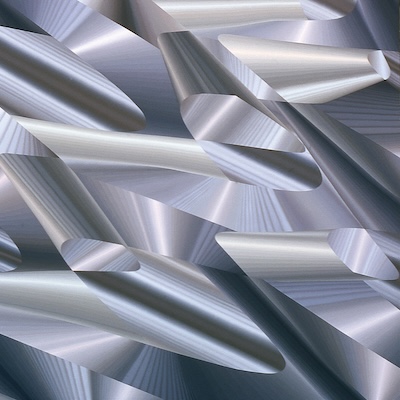
The album cover features the painting Self Portrait (1972) by the legendary artist Samia Halaby. Part of a series focused on helixes and cycloids, Self Portrait is a study of light refractions on aluminium: the abstract reflection of the artist warped into metallic angularity. Halaby is the recipient of the 2025 Munch Award.
The release of METLASR will be accompanied by two music videos.
Iljal was directed by Aron Sanchez-Baranda, known for his xenological visual documentation of Californian tidal systems. Using temporally manipulated images of sea anemones, Sanchez-Baranda evokes the underlying tentacurality and the unreal-real organicity of the music’s melodic shapes with motions of multi-colored, bio-morphic abstractions.
Štoniljid is a ballet of light reflecting on agitated water. High-resolution cymatic light cyphers and bioluminescent algae dance and shift in rhythm to the polyphonous percussive vibrations, erupting in luminescence in response to bursting gongs, drums and structural crest. The video was directed by Friedman, using footage made in collaboration with the artist Andreas Greiner.
Tyler Friedman’s music vacillates between cosmic impulses and analytical inclinations. Escaping the rift between post-club experimentalism and the theory-driven partition of contemporary art, his output spans numerous releases, soundtracks, installations, collaborations and performances and draws on an unwieldy arsenal of divergent references and tactics. Friedman’s solo output focuses on a lysergic strain of dubbed minimalism, equally indebted to late-00s techno and the downtown avant-garde. Created largely in a feedback loop with modular synthesizers and Max/MSP, his sequences and generative patterns are infused with an intuitive complexity and alchemical formalism. Current trajectories point further away from the strictures of club music and have been increasingly oriented towards alternative tunings and uncanny harmonic interactions. His music has been released on Sweden’s Kontra Musik, Arjuna Records and Tokyo-based Protection. In the context of contemporary art, Friedman works to manifest conceptual constellations in sonic form. He has been responsible for the sonics of collaborative projects that have been commissioned and presented worldwide, including at dOCUMENTA(13), Haus der Kulturen der Welt, Manifesta, Cycle Music and Arts Festival and the Yokohama Triennale among others. Recent authored installation works have included A Sphere of Water Orbiting a Star, a large-scale multichannel piece with long-term collaborators the Otolith Group wormholing the speculative aqua-physics of the Drexciyan mythos, and The Molecular Ordering of Computational Plants, a quadraphonic science-fiction narrative, made alongside artist Andreas Greiner, charting the post-human evolutionary conclusion as a biological return to seaborne algae.
In April 2026, he will present his debut solo exhibition at Gallery Gudmundsdottir in Berlin.
Friedman is currently based between Venice and Berlin.
REGARDING SELF PORTRAIT, SAMIA HALABY, 1972
I gaze at this painting of mine that I created fifty-three years ago and wonder who I was then. The young me that I remember was intensely exploring her discoveries, unaware how completely she lived inside them. What I see now is more than what she saw then. As I look now at this painting, I have become a swimmer in the air stretching to the rhythms of dipping diagonals, hearing a gentle sound of metal rising slowly in a translucent world, reflected everywhere like the highlights of dawn rising in my mind filled with lights and reflections everywhere.
But then, that Samia of fifty-three years ago was engrossed, deeply focused, enclosed in her thoughts and saw less than I see now. Turning away from painting geometric still lives that I built myself, in the early 1970s I began plotting geometric rectangles on graph paper. The graph paper drew me into a new world. I moved on to painting conical helixes and off I went sinking in a new bath of ideas. When I formed the shapes of the helixes, I remembered some of my favorite lessons from my education: the nature of reflective surfaces of metals.
I found a piece of aluminum that I could bend so that it would reflect the room and, looking at it carefully, I began working. It was a year later when I realized that what was reflected in the painting was the ceiling of my studio full of neon lights. They have become an orchestra of gentle metallic ribbons of light. It was also a year or more later that I realized the dark soft stripes of black and brown in various parts of the painting were reflections of my face looking down at the metal in my hand. Because it is not a self-portrait in a flat mirror, and because my presence in the painting was unintended, it feels as though the painting is unexpectedly looking back at me. I hope viewers can experience this sensation of swimming in air in a world that recognizes them.
—Samia Halaby, March 8, 2025
MUSIC FOR VIRTUAL IDIOPHONE ENSEMBLE AND MODULAR SYNTHESIZER
Composition and Production TYLER FRIEDMAN
Recorded and Mixed at SAKHA STUDIOS BERLIN
Mastering MIKE GRINSER AT MANMADE
Cover Art SELF PORTRAIT (1972), SAMIA HALABY, OIL ON CANVAS
Layout TYLER FRIEDMAN
Thanks to ARON, KHYAM, BRIAN, RABIH, NATASCHA, TANJA, MARYLOU, ULF, KODWO, ANJALI, DAVIDE AND ANTONIA
RAD_01 – All rights reserved
(P)+(C) 2026 Radicant_Editions
All rights reserved. The musical contents may not be published, broadcast, or redistributed in whole or part without the express written permission.